
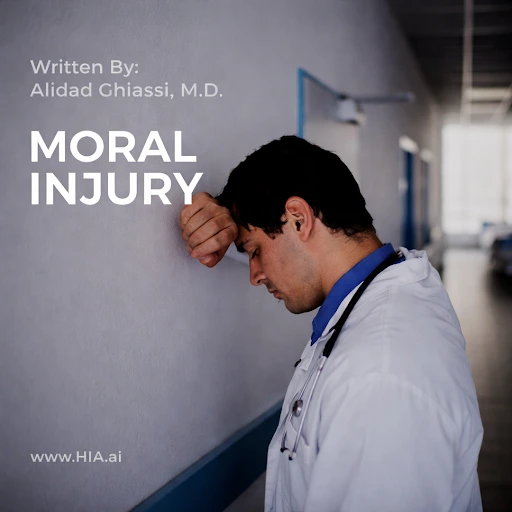
The ability to take care of sick patients is a duty and privilege that attracts individuals with a strong moral compass. These bright young minds progress through grueling education and training, sacrificing time, relationships, sleep, and more in the name of their commitment to help the ill and suffering. Along this rigorous path and through clinical experience, the fundamental ideals healthcare workers begin with can be eroded, leading to moral injury.
What Is Moral Injury?
Moral injury can occur when someone engages in, fails to prevent, or witnesses acts that conflict with their values or beliefs. It’s an identity wound that leads to a spinning moral compass, guilt, anger, anxiety, lack of sleep, and other deleterious effects. These feelings may occur in the absence of a formal disorder.
While rates of moral injury seem to be highest among veterans, recent studies show the rates are similar among healthcare workers. According to a recent study, 51% of healthcare workers indicated distress over others’ morally injurious behavior compared to 46% of veterans. 18% of healthcare workers were concerned over their own morally injurious behavior compared to 24% of veterans.
How has it come to a point where a civilian healthcare worker’s experience compares to that of a combat veteran? After all, improved treatments and more advanced technology allow medical professionals to save lives and restore health in ways we’ve never seen before. One might assume that doctors are happier than ever since they do not see as much pain and loss in their daily practice. But quite the opposite is transpiring – a pandemic of moral injury is occurring.
What’s Causing Moral Injury?
Many recent instances of moral injury can be connected to situations healthcare workers face due to the COVID-19 pandemic. Healthcare workers are stretched thin, as are supplies, and the ability to render care is hamstrung. The situations can leave an indelible mark on people who strive to properly care for the sick and dying.
On top of these dire issues, there is the tedious administrative work and lack of time with patients that existed long before COVID-19. Providers are left with small windows to treat and educate patients, which hurts both sides of the patient/physician relationship. Patients may not trust doctors, and the lack of patient adherence to treatment plans and instructions can jade the most optimistic healthcare worker.
These moral injuries are linked to anxiety, depression, burnout, increased suicide rates, and exodus from healthcare. Healthcare workers and leaders now face the question of how to leverage knowledge and technology to address the current moral injury crisis.
What Are the Solutions?
The problem is that there are a variety of reasons behind the pandemic of moral injury in our healthcare system. Healthcare leaders need to address the most common thread: doctors and nurses can't provide the care that patients need. The conflict between the deeply held moral beliefs of healthcare workers and the actual care they’re able to provide is a significant component of moral injury.
Luckily, the abundance of modern technology, particularly AI, can help relieve some of healthcare workers’ burdens. I don't have to look far to find such examples, so many seasoned and new players are entering the AI space with the aim of improving care. Whether it's predictive analytics that automatically assign readmission risk scores, remote triage, or even AI systems that analyze clinical documentation to help uncover missed diagnosis, the tech is out there. However, the majority of those AI-embedded tools are focused on improving care or outcomes through disease identification and risk stratification.
What's missing? As a physician, the thing that keeps me up at night are the sudden moments of recall, where I worry that I may have forgotten to tell a patient something important about their condition, procedure, or prognosis. I stress over whether or not my patients will remember all of the important things I told them, or if in their moments of doubt they'll turn to the internet and get more misinformation than they can handle.
Knowing that patients forget about 80% of what they're told before they even arrive home, I sometimes feel a sense of defeat before we even begin. Am I giving my patients everything they need to truly understand their health and empowering them, or am I treating people at the point of care and hoping for the best when they leave. For me, for my personality type, this unknown is morally injurious.
Leveraging AI to Support Providers
In my role as CMO for HIA Technologies, I get to help change this dynamic for healthcare providers. HIA Technologies is an innovative company dedicated to leveraging AI for doctors and nurses. HIA’s AI solutions help providers not only augment their repetitive administrative and educational tasks but also give them the ability to extend their conversations beyond the office and hospital doors.
The Aivio™ we've created is a secure, interactive environment where a physician's digital assistant reinforces the education provided and answers real-time questions with AI that's physician-controlled. This approach allows healthcare workers to amplify their reach and educate their patients beyond the compressed seven-minute visit, improving often-rushed discharges or inadequate consents.
Clinicians no longer need to feel that they did not give adequate education or be worried that patients did not understand their healthcare journey’s ups and downs, which can lead to confusion, lack of understanding, and poor outcomes. Instead, physicians and nurses can thoroughly communicate the necessary, yet repetitive, medical information in an engaging interactive platform.
Even though this is not a cure-all for moral injury, it is a powerful tool that relieves the anxiety and pressure on healthcare professionals to deliver all the needed medical information at the point of care. A hybrid model of high-touch and high-tech care delivery is the first step in providing tools that can let clinicians commit to their lifelong oath of helping the sick.
For more information on HIA’s interactive solutions, contact HIA Technologies or connect with Alidad Ghiassi, M.D. on LinkedIn.
Nieuwsma, J.A., O’Brien, E.C., Xu, H. et al. Patterns of Potential Moral Injury in Post-9/11 Combat Veterans and COVID-19 Healthcare Workers. J GEN INTERN MED 37, 2033–2040 (2022). https://doi.org/10.1007/s11606-022-07487-4